Malocclusion: Disease of Civilization, Part VIII

Three Case Studies in Occlusion

In this post, I'll review three cultures with different degrees of malocclusion over time, and try to explain how the factors I've discussed may have played a role.

The Xavante of Simoes Lopes

In 1966, Dr. Jerry D. Niswander published a paper titled "The Oral Status of the Xavantes of Simoes Lopes", describing the dental health and occlusion of 166 Brazilian hunter-gatherers from the Xavante tribe (free full text). This tribe was living predominantly according to tradition, although they had begun trading with the post at Simoes Lopes for some foods. They made little effort to clean their teeth. They were mostly but not entirely free of dental cavities:
Approximately 33% of the Xavantes at Simoes Lopes were caries free. Neel et al. (1964) noted almost complete absence of dental caries in the Xavante village at Sao Domingos. The difference in the two villages may at least in part be accounted for by the fact that, for some five years, the Simoes Lopes Xavante have had access to sugar cane, whereas none was grown at Sao Domingos. It would appear that, although these Xavantes still enjoy relative freedom from dental caries, this advantage is disappearing after only six years of permanent contact with a post of the Indian Protective Service.
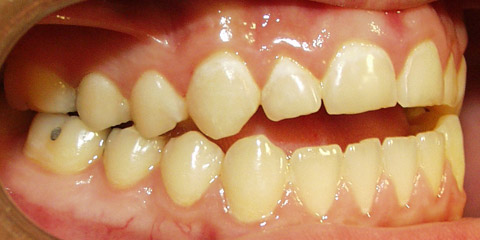
The most striking thing about these data is the occlusion of the Xavante. 95 percent had ideal occlusion. The remaining 5 percent had nothing more than a mild crowding of the incisors (front teeth). Niswander didn't observe a single case of underbite or overbite. This would have been truly exceptional in an industrial population. Niswander continues:
Characteristically, the Xavante adults exhibited broad dental arches, almost perfectly aligned teeth, end-to-end bite, and extensive dental attrition. At 18-20 years of age, the teeth were so worn as to almost totally obliterate the cusp patterns, leaving flat chewing surfaces.
The Xavante were clearly hard on their teeth, and their predominantly hunter-gatherer lifestyle demanded it. They practiced a bit of "rudimentary agriculture" of corn, beans and squash, which would sustain them for a short period of the year devoted to ceremonies. Dr. James V. Neel describes their diet (free full text):
Despite a rudimentary agriculture, the Xavante depend very heavily on the wild products which they gather. They eat numerous varieties of roots in large quantities, which provide a nourishing, if starchy, diet. These roots are available all year but are particularly important in the Xavante diet from April to June in the first half of the dry season when there are no more fruits. The maize harvest does not last long and is usually saved for a period of ceremonies. Until the second harvest of beans and pumpkins, the Xavante subsist largely on roots and palmito (Chamacrops sp.), their year-round staples.

From late August until mid-February, there are also plenty of nuts and fruits available. The earliest and most important in their diet is the carob or ceretona (Ceretona sp.), sometimes known as St. John's bread. Later come the fruits of the buriti palm (Mauritia sp.) and the piqui (Caryocar sp.). These are the basis of the food supply throughout the rainy season. Other fruits, such as mangoes, genipapo (Genipa americana), and a number of still unidentified varieties are also available.

The casual observer could easily be misled into thinking that the Xavante "live on meat." Certainly they talk a great deal about meat, which is the most highly esteemed food among them, in some respects the only commodity which they really consider "food" at all... They do not eat meat every day and may go without meat for several days at a stretch, but the gathered products of the region are always available for consumption in the community.

Recently, the Xavante have begun to eat large quantities of fish.
The Xavante are an example of humans living an ancestral lifestyle, and their occlusion shows it. They have the best occlusion of any living population I've encountered so far. Here's why I think that's the case:
  • A nutrient-rich, whole foods diet, presumably including organs.
  • On-demand breast feeding for two or more years.
  • No bottle-feeding or modern pacifiers.
  • Tough foods on a regular basis.
I don't have any information on how the Xavante have changed over time, but Niswander did present data on another nearby (and genetically similar) tribe called the Bakairi that had been using a substantial amount of modern foods for some time. The Bakairi, living right next to the Xavante but eating modern foods from the trading post, had 9 times more malocclusion and nearly 10 times more cavities than the Xavante. Here's what Niswander had to say:
Severe abrasion was not apparent among the Bakairi, and the dental arches did not appear as broad and massive as in the Xavantes. Dental caries and malocclusion were strikingly more prevalent; and, although not recorded systematically, the Bakairi also showed considerably more periodontal disease. If it can be assumed that the Bakairi once enjoyed a freedom from dental disease and malocclusion equal to that now exhibited by the Xavantes, the available data suggest that the changes in occlusal patterns as well as caries and periodontal disease have been too rapid to be accounted for by an hypothesis involving relaxed [genetic] selection.
The Masai of Kenya

The Masai are traditionally a pastoral people who live almost exclusively from their cattle. In 1945, and again in 1952, Dr. J. Schwartz examined the teeth of 408 and 273 Masai, respectively (#1 free full text; #2 ref). In the first study, he found that 8 percent of Masai showed some form of malocclusion, while in the second study, only 0.4 percent of Masai were maloccluded. Although we don't know what his precise criteria were for diagnosing malocclusion, these are still very low numbers.

In both studies, 4 percent of Masai had cavities. Between the two studies, Schwartz found 67 cavities in 21,792 teeth, or 0.3 percent of teeth affected. This is almost exactly what Dr. Weston Price found when he visited them in 1935. From Nutrition and Physical Degeneration, page 138:
In the Masai tribe, a study of 2,516 teeth in eighty-eight individuals distributed through several widely separated manyatas showed only four individuals with caries. These had a total of ten carious teeth, or only 0.4 per cent of the teeth attacked by tooth decay.
Dr. Schwartz describes their diet:
The principal food of the Masai is milk, meat and blood, the latter obtained by bleeding their cattle... The Masai have ample means with which to get maize meal and fresh vegetables but these foodstuffs are known only to those who work in town. It is impossible to induce a Masai to plant their own maize or vegetables near their huts.
This is essentially the same description Price gave during his visit. The Masai were not hunter-gatherers, but their traditional lifestyle was close enough to allow good occlusion. Here's why I think the Masai had good occlusion:
  • A nutrient-dense diet rich in protein and fat-soluble vitamins from pastured dairy.
  • On-demand breast feeding for two or more years.
  • No bottle feeding or modern pacifiers.
The one factor they lack is tough food. Their diet, composed mainly of milk and blood, is predominantly liquid. Although I think food toughness is a factor, this shows that good occlusion is not entirely dependent on tough food.

Sadly, the lifestyle and occlusion of the Masai has changed in the intervening decades. A paper from 1992 described their modern diet:
The main articles of diet were white maize, [presumably heavily sweetened] tea, milk, [white] rice, and beans. Traditional items were rarely eaten... Milk... was not mentioned by 30% of mothers.
A paper from 1993 described the occlusion of 235 young Masai attending rural and peri-urban schools. Nearly all showed some degree of malocclusion, with open bite alone affecting 18 percent.

Rural Caucasians in Kentucky

It's always difficult to find examples of Caucasian populations living traditional lifestyles, because most Caucasian populations adopted the industrial lifestyle long ago. That's why I was grateful to find a study by Dr. Robert S. Corruccini, published in 1981, titled "Occlusal Variation in a Rural Kentucky Community" (ref).

This study examined a group of isolated Caucasians living in the Mammoth Cave region of Kentucky, USA. Corruccini arrived during a time of transition between traditional and modern foodways. He describes the traditional lifestyle as follows:
Much of the traditional way of life of these people (all white) has been maintained, but two major changes have been the movement of industry and mechanized farming into the area in the last 25 years. Traditionally, tobacco (the only cash crop), gardens, and orchards were grown by each family. Apples, pears, cherries, plums, peaches, potatoes, corn, green beans, peas, squash, peppers, cucumbers, and onions were grown for consumption, and fruits and nuts, grapes, and teas were gathered by individuals. In the diet of these people, dried pork and fried [presumably in lard], thick-crust cornbread (which were important winter staples) provided consistently stressful chewing. Hunting is still very common in the area.
Although it isn't mentioned in the paper, this group, like nearly all traditionally-living populations, probably did not waste the organs or bones of the animals it ate. Altogether, it appears to be an excellent and varied diet, based on whole foods, and containing all the elements necessary for good occlusion and overall health.

The older generation of this population has the best occlusion of any Caucasian population I've ever seen, rivaling some hunter-gatherer groups. This shows that Caucasians are not genetically doomed to malocclusion. The younger generation, living on more modern foods, shows very poor occlusion, among the worst I've seen. They also show narrowed arches, a characteristic feature of deteriorating occlusion. One generation is all it takes. Corruccini found that a higher malocclusion score was associated with softer, more industrial foods.

Here are the reasons I believe this group of Caucasians in Kentucky had good occlusion:
  • A nutrient-rich, whole foods diet, presumably including organs.
  • Prolonged breast feeding.
  • No bottle-feeding or modern pacifiers.
  • Tough foods on a regular basis.
Common Ground

I hope you can see that populations with excellent teeth do certain things in common, and that straying from those principles puts the next generation at a high risk of malocclusion. Malocclusion is a serious problem that has major implications for health, well-being and finances. In the next post, I'll give a simplified summary of everything I've covered in this series. Then it's back to our regularly scheduled programming.

Malocclusion: Disease of Civilization, Part VII

Jaw Development During Adolescence

Beginning at about age 11, the skull undergoes a growth spurt. This corresponds roughly with the growth spurt in the rest of the body, with the precise timing depending on gender and other factors. Growth continues until about age 17, when the last skull sutures cease growing and slowly fuse. One of these sutures runs along the center of the maxillary arch (the arch in the upper jaw), and contributes to the widening of the upper arch*:

This growth process involves MGP and osteocalcin, both vitamin K-dependent proteins. At the end of adolescence, the jaws have reached their final size and shape, and should be large enough to accommodate all teeth without crowding. This includes the third molars, or wisdom teeth, which will erupt shortly after this period.

Reduced Food Toughness Correlates with Malocclusion in Humans

When Dr. Robert Corruccini published his seminal paper in 1984 documenting rapid changes in occlusion in cultures around the world adopting modern foodways and lifestyles (see this post), he presented the theory that occlusion is influenced by chewing stress. In other words, the jaws require good exercise on a regular basis during growth to develop normal-sized bones and muscles. Although Dr. Corruccini wasn't the first to come up with the idea, he has probably done more than anyone else to advance it over the years.

Dr. Corruccini's paper is based on years of research in transitioning cultures, much of which he conducted personally. In 1981, he published a study of a rural Kentucky community in the process of adopting the modern diet and lifestyle. Their traditional diet was predominantly dried pork, cornbread fried in lard, game meat and home-grown fruit, vegetables and nuts. The older generation, raised on traditional foods, had much better occlusion than the younger generation, which had transitioned to softer and less nutritious modern foods. Dr. Corruccini found that food toughness correlated with proper occlusion in this population.

In another study published in 1985, Dr. Corruccini studied rural and urban Bengali youths. After collecting a variety of diet and socioeconomic information, he found that food toughness was the single best predictor of occlusion. Individuals who ate the toughest food had the best teeth. The second strongest association was a history of thumb sucking, which was associated with a higher prevalence of malocclusion**. Interestingly, twice as many urban youths had a history of thumb sucking as rural youths.

Not only do hunter-gatherers eat tough foods on a regular basis, they also often use their jaws as tools. For example, the anthropologist and arctic explorer Vilhjalmur Stefansson described how the Inuit chewed their leather boots and jackets nearly every day to soften them or prepare them for sewing. This is reflected in the extreme tooth wear of traditional Inuit and other hunter-gatherers.

Soft Food Causes Malocclusion in Animals

Now we have a bunch of associations that may or may not represent a cause-effect relationship. However, Dr. Corruccini and others have shown in a variety of animal models that soft food can produce malocclusion, independent of nutrition.

The first study was conducted in 1951. Investigators fed rats typical dry chow pellets, or the same pellets that had been crushed and softened in water. Rats fed the softened food during growth developed narrow arches and small mandibles (lower jaws) relative to rats fed dry pellets.

Other research groups have since repeated the findings in rodents, pigs and several species of primates (squirrel monkeys, baboons, and macaques). Animals typically developed narrow arches, a central aspect of malocclusion in modern humans. Some of the primates fed soft foods showed other malocclusions highly reminiscent of modern humans as well, such as crowded incisors and impacted third molars. These traits are exceptionally rare in wild primates.

One criticism of these studies is that they used extremely soft foods that are softer than the typical modern diet. This is how science works: you go for the extreme effects first. Then, if you see something, you refine your experiments. One of the most refined experiments I've seen so far was published by Dr. Daniel E. Leiberman of Harvard's anthropology department. They used the rock hyrax, an animal with a skull that bears some similarities to the human skull***.

Instead of feeding the animals hard food vs. mush, they fed them raw and dried food vs. cooked. This is closer to the situation in humans, where food is soft but still has some consistency. Hyrax fed cooked food showed a mild jaw underdevelopment reminiscent of modern humans. The underdeveloped areas were precisely those that received less strain during chewing.

Implications and Practical Considerations

Besides the direct implications for the developing jaws and face, I think this also suggests that physical stress may influence the development of other parts of the skeleton. Hunter-gatherers generally have thicker bones, larger joints, and more consistently well-developed shoulders and hips than modern humans. Physical stress is part of the human evolutionary template, and is probably critical for the normal development of the skeleton.

I think it's likely that food consistency influences occlusion in humans. In my opinion, it's a good idea to regularly include tough foods in a child's diet as soon as she is able to chew them properly and safely. This probably means waiting at least until the deciduous (baby) molars have erupted fully. Jerky, raw vegetables and fruit, tough cuts of meat, nuts, dry sausages, dried fruit, chicken bones and roasted corn are a few things that should stress the muscles and bones of the jaws and face enough to encourage normal development.


* These data represent many years of measurements collected by Dr. Arne Bjork, who used metallic implants in the maxilla to make precise measurements of arch growth over time in Danish youths. The graph is reproduced from the book A Synopsis of Craniofacial Growth, by Dr. Don M. Ranly. Data come from Dr. Bjork's findings published in the book Postnatal Growth and Development of the Maxillary Complex. You can see some of Dr. Bjork's data in the paper "Sutural Growth of the Upper Face Studied by the Implant Method" (free full text).


** I don't know if this was statistically significant at p less than 0.05. Dr. Corruccini uses a cutoff point of p less than 0.01 throughout the paper. He's a tough guy when it comes to statistics!

*** Retrognathic.

Malocclusion: Disease of Civilization, Part VI

Early Postnatal Face and Jaw Development

The face and jaws change more from birth to age four than at any other period of development after birth. At birth, infants have no teeth and their skull bones have not yet fused, allowing rapid growth. This period has a strong influence on the development of the jaws and face. The majority of malocclusions are established by the end this stage of development. Birth is the point at which the infant begins using its jaws and facial musculature in earnest.

The development of the jaws and face is very plastic, particularly during this period. Genes do not determine the absolute size or shape of any body structure. Genes carry the blueprint for all structures, and influence their size and shape, but structures develop relative to one another and in response to the forces applied to them during growth. This is how orthodontists can change tooth alignment and occlusion by applying force to the teeth and jaws.

Influences on Early Postnatal Face and Jaw Development

In 1987, Miriam H. Labbok and colleagues published a subset of the results of the National Health Interview survey (now called NHANES) in the American Journal of Preventive Medicine. Their article was provocatively titled "Does Breast-feeding Protect Against Malocclusion"? The study examined the occlusion of nearly 10,000 children, and interviewed the parents to determine the duration of breast feeding. Here's what they found:

The longer the infants were breastfed, the lower their likelihood of major malocclusion. The longest category was "greater than 12 months", in which the prevalence of malocclusion was less than half that of infants who were breastfed for three months or less. Hunter-gatherers and other non-industrial populations typically breastfeed for 2-4 years, but this is rare in affluent nations. Only two percent of the mothers in this study breastfed for longer than one year.

The prevalence and duration of breastfeeding have increased dramatically in the US since the 1970s, with the prevalence doubling between 1970 and 1980 (NHANES). The prevalence of malocclusion in the US has decreased somewhat in the last half-century, but is still very common (NHANES).

Several, but not all studies have found that infants who were breastfed have a smaller risk of malocclusion later in life (1, 2, 3). However, what has been more consistent is the association between non-nutritive sucking and malocclusion. Non-nutritive sucking (NNS) is when a child sucks on an object without getting calories out of it. This includes pacifier sucking, which is strongly associated with malocclusion*, and finger sucking, which is also associated to a lesser degree.

The longer a child engages in NNS, the higher his or her risk of malocclusion. The following graph is based on data from a study of nearly 700 children in Iowa (free full text). It charts the prevalence of three types of malocclusion (anterior open bite, posterior crossbite and excessive overjet) broken down by the duration of the NNS habit:

As you can see, there's a massive association. Children who sucked pacifiers or their fingers for more than four years had a 71 percent chance of having one of these three specific types of malocclusion, compared with 14 percent of children who sucked for less than a year. The association between NNS and malocclusion appeared after two years of NNS. Other studies have come to similar conclusions, including a 2006 literature review (1, 2, 3).

Bottle feeding, as opposed to direct breast feeding, is also associated with a higher risk of malocclusion (1, 2). One of the most important functions of breast feeding may be to displace NNS and bottle feeding. Hunter-gatherers and non-industrial cultures breast fed their children on demand, typically for 2-4 years, in addition to giving them solid food.

In my opinion, it's likely that NNS beyond two years of age, and bottle feeding to a lesser extent, cause a large proportion of the malocclusions in modern societies. Pacifier use seems to be particularly problematic, and finger sucking to a lesser degree.

How Do Breastfeeding, Bottle Feeding and NNS Affect Occlusion?

Since jaw development is influenced by the forces applied to them, it makes sense that the type of feeding during this period could have a major impact on occlusion. Children who have a prolonged pacifier habit are at high risk for open bite, a type of malocclusion in which the incisors don't come together when the jaws are closed. You can see a picture here. The teeth and jaws mold to the shape of the pacifier over time. This is because the growth patterns of bones respond to the forces that are applied to them. I suspect this is true for other parts of the skeleton as well.

Any force applied to the jaws that does not approximate the natural forces of breastfeeding or chewing and swallowing food, will put a child at risk of malocclusion during this period of his or her life. This includes NNS and bottle feeding. Pacifier sucking, finger sucking and bottle feeding promote patterns of muscular activity that result in weak jaw muscles and abnormal development of bony structures, whereas breastfeeding, chewing and swallowing strengthen jaw muscles and promote normal development (review article). This makes sense, because our species evolved in an environment where the breast and solid foods were the predominant objects that entered a child's mouth.

What Can We do About it?

In an ideal world (ideal for occlusion), mothers would breast feed on demand for 2-4 years, and introduce solid food about halfway through the first year, as our species has done since the beginning of time. For better or worse, we live in a different world than our ancestors, so this strategy will be difficult or impossible for many people. Are there any alternatives?

Parents like bottle feeding because it's convenient. Milk can be prepared in advance, the mother doesn't have to be present, feeding takes less time, and the parents can see exactly how much milk the child has consumed. One alternative to bottle feeding that's just as convenient is cup feeding. Cup feeding, as opposed to bottle feeding, promotes natural swallowing motions, which are important for correct development. The only study I found that examined the effect of cup feeding on occlusion found that cup-fed children developed fewer malocclusion and breathing problems than bottle-fed children.

Cup feeding has a long history of use. Several studies have found it to be safe and effective. It appears to be a good alternative to bottle feeding, that should not require any more time or effort.

What about pacifiers? Parents know that pacifiers make babies easier to manage, so they will be reluctant to give them up. Certain pacifier designs may be more detrimental than others. I came across the abstract of a study evaluating an "orthodontic pacifier" called the Dentistar, made by Novatex. The frequency of malocclusion was much lower in children who did not use a pacifier or used the Dentistar, than in those who used a more conventional pacifier. This study was funded by Novatex, but was conducted at Heinrich Heine University in Dusseldorf, Germany**. The pacifier has a spoon-like shape that allows normal tongue movement and exerts minimal pressure on the incisors. There may be other brands with a similar design.

The ideal is to avoid bottle feeding and pacifiers entirely. However, cup feeding and orthodontic pacifiers appear to be acceptable alternatives that minimize the risk of malocclusion during this critical developmental window.


* Particularly anterior open bite and posterior crossbite.

** I have no connection whatsoever to this company. I think the results of the trial are probably valid, but should be replicated.